Buttery Soft or Supportive? Why You Usually Cannot Have Both
Quick Answer: Buttery softness comes from a brushed surface and low fabric tension — the yarn is loosely knit and the face is raised, which feels plush and stretches easily. Support comes from the opposite: high elastane, tight knit density, and recovery force pulling back against your body. A fabric engineered to feel soft against skin gives up some of the resistance that holds a squat, and one engineered to hold gives up plushness. Pick soft for lounge, walks, yoga, and travel; pick supportive for lifting, running, and anything high-impact.

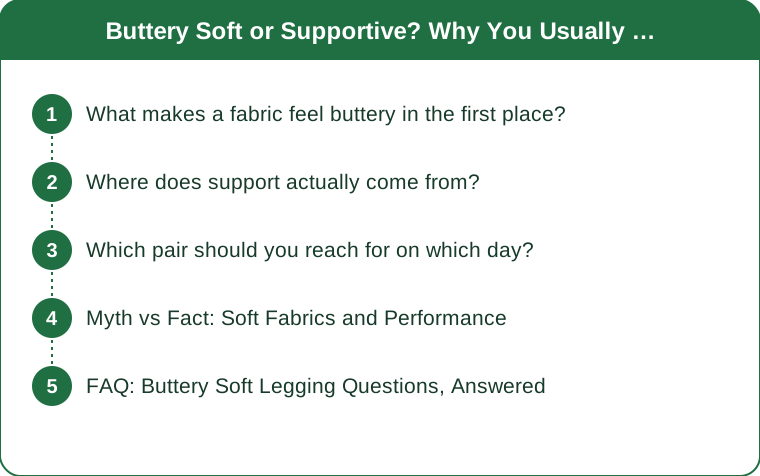
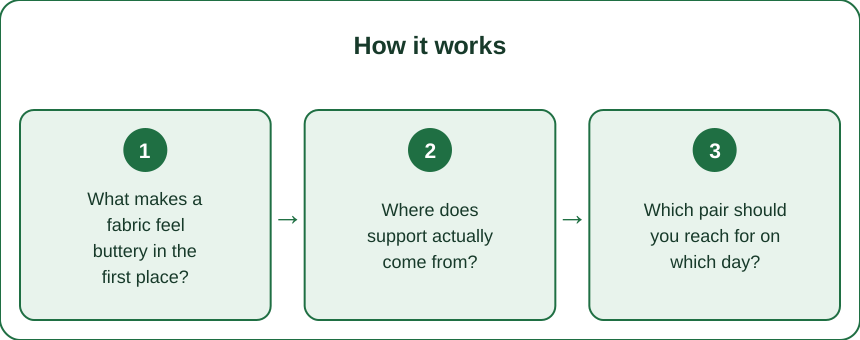
What makes a fabric feel buttery in the first place?
Three things, and none of them are about support.
Brushing. The fabric face is mechanically raised so tiny fibers stand up. Your skin touches those fiber tips rather than the woven surface, which registers as softness. Brushing also traps a thin layer of air, which is why buttery fabrics feel warmer.
Yarn fineness. Finer filaments — often micro-denier polyamide — bend more easily against skin. Coarser yarn is more durable and less pleasant to touch, and most fabrics trade one for the other.
Knit looseness. A slightly more open knit gives more immediately under pressure. That first easy give is a large part of what people describe as buttery.
All three reduce the fabric’s ability to resist deformation. Brushing removes surface material, fine yarn is weaker per strand, and a looser knit has less structure to push back with.
So the softness is not a marketing coat applied over a supportive base. It is a set of structural choices, and those choices have costs.
Where does support actually come from?
Elastane percentage and knit tension, working together.
A supportive legging typically runs 18 to 28 percent elastane in a dense knit. The fabric is smaller than your leg at rest and returns force against it constantly. That constant return is what holds tissue steady during impact and what keeps the waistband from migrating.
Recovery is the property that matters most and the one nobody checks. It is the fabric’s ability to snap back to its original dimensions after being stretched. High recovery means the pair still holds at hour four. Low recovery means it holds for twenty minutes and then bags at the knee.
Here is the direct conflict: the brushing that creates butteriness damages some of the elastane’s ability to recover, because the process abrades the surface. Manufacturers compensate by using more elastane, which raises cost, or by accepting less support, which is the common answer at accessible prices.
A quick test at home: stretch the fabric widthwise as far as it goes, hold for five seconds, and release. If a visible ripple or slack remains, recovery is low. That pair belongs in the soft category no matter what the tag claims.

Which pair should you reach for on which day?
Buttery soft is right for: yoga and stretching, walking, travel days, working from home, easy recovery sessions, and any day when comfort against skin is the priority. It is also the better choice in cool weather, since the brushed surface holds warmth.
Supportive is right for: lifting, running, HIIT, jump-based classes, long days on your feet, and anything where you need the waistband to stay exactly where you put it. It is also better in heat, because dense flat-face knits move sweat faster than brushed ones.
The overlap case is squat-proofing, and it is worth separating from support. A buttery fabric can be perfectly opaque if it is knit densely enough — softness and sheerness are not the same axis. Test opacity separately by bending in front of a mirror, and do not assume a plush pair is see-through or that a compressive one is not.
For most people, the honest answer is two pairs, clearly labeled in your head. Trying to find one legging that does both usually produces a pair that does neither especially well, and costs more than the two would have.
Myth vs Fact: Soft Fabrics and Performance
Myth: Buttery soft means low quality. Fact: It means a different engineering target. A well-made brushed fabric outlasts a badly made compressive one easily; the question is what job you bought it for.
Myth: More elastane always means more support. Fact: Elastane content without knit density gives you stretch, not hold. A 25 percent elastane fabric in a loose knit stretches beautifully and supports nothing.
Myth: If it feels tight, it is compressive. Fact: Tight at rest and supportive under load are different. The relevant question is what happens at the bottom of a squat, not what it feels like standing in a fitting room.
Myth: Softness wears off, so it does not matter. Fact: It fades from fabric softener, high heat, and washing with abrasive items — mostly reversible habits. Cold wash, no softener, air dry, and the brushed face lasts far longer than people expect.
Myth: Compression fabrics are uncomfortable. Fact: They are uncomfortable when sized wrong. Correctly sized compression is unremarkable to wear; it is the size-too-small version that people remember.
FAQ: Buttery Soft Legging Questions, Answered
Can a legging be both soft and squat-proof?
Yes. Opacity depends on knit density and color, not on hand feel. Many brushed fabrics are completely opaque. Support is the property that genuinely conflicts with softness, not coverage.
Why did my buttery pair stop feeling soft?
Usually fabric softener coating the raised fibers, or heat from a dryer melting fine filaments flat. Wash cold, skip the softener, and air dry. Some of the hand feel returns; heat damage does not.
Is buttery soft bad for hot weather?
Generally yes. The raised surface traps air and holds moisture against skin. In late summer heat, a flat-face fabric moves sweat noticeably faster.
How do I test support before buying?
Squat fully in the fitting room and stand up. Check whether the waistband stayed put and whether the knee area kept its shape. A pair that needs adjusting after one squat will need adjusting all day.
TL;DR:
- Softness comes from brushing, fine yarn, and a looser knit — all of which reduce the fabric’s ability to push back.
- Support comes from high elastane plus dense knit tension, and the property to check is recovery, not stretch.
- Test recovery by stretching, holding five seconds, and releasing: leftover slack means low support.
- Soft for yoga, walks, travel, and cool weather; supportive for lifting, running, impact, and heat.
- Opacity is a separate question from support — plush pairs can be fully squat-proof.
Both fabrics are good at what they were built for. The frustration comes almost entirely from asking one pair to do the other pair’s job.
See It in Motion
Seen here: High Waist Embossed Yoga Leggings with Side Pockets — shop it on bubblelime.com
Keep Reading
This article is for general informational and styling purposes only. Fit, sizing, and product availability may vary.